
Card Combination
King of Swords and Justice
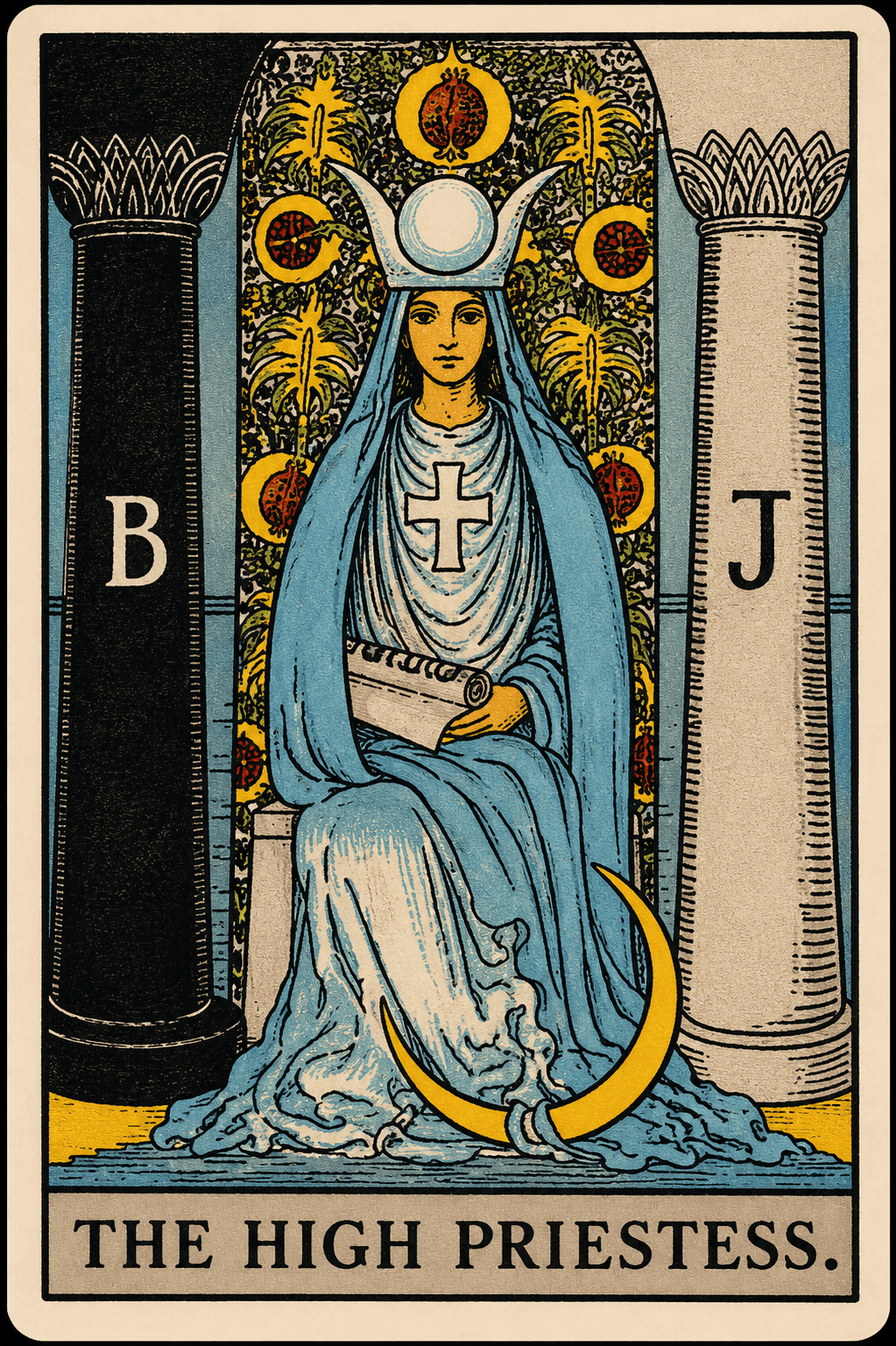
King of Swords and Justice together describe judgement exercised by someone equipped for it. The King of Swords decides from principle rather than feeling; Justice is the standard being applied. Together they describe an authority that can be reasoned with, provided the reasoning is sound.
How these two cards change each other
This is the part neither card’s own page can tell you — what each one does to the other when they land together.
Justice constrains the King of Swords. Intellectual authority unchecked becomes certainty, which is the King's characteristic failure. Justice supplies an external standard he is answerable to.
The King of Swords gives Justice a person. Justice is impersonal and slow. Embodied in someone specific, the standard is applied by judgement rather than by procedure, which is faster and depends on the individual.
Together they describe the best case for authority: someone competent applying a real standard. That is worth naming because most authority pairings describe something less favourable.
King of Swords and Justice in context
In dealing with authority
A decision-maker who will respond to a well-made argument. The pairing's practical content is that preparation matters more than appeal: emotional pressure works badly here and evidence works well.
In professional judgement
Frequently a lawyer, doctor, adjudicator or senior figure whose assessment is principled. The reading favours trusting the process while still bringing your own material to it.
In your own decisions
Read internally, this describes deciding something on principle rather than preference. Difficult where the principled answer is not the one you wanted, which is generally when the pairing appears.
When one or both are reversed
King of Swords reversed, Justice upright
A fair standard applied by someone cold or arbitrary. The rules are sound and the person applying them is not, which is a specific and recognisable difficulty.
Justice reversed, King of Swords upright
Confident judgement without an external standard. Someone deciding by their own conviction, which can be right and cannot be argued with.
Both reversed
Neither principle nor standard. Usually a decision being made on grounds nobody will state, and generally not one worth appealing on the merits.
The common misreading
Often said: The King of Swords means someone harsh who cannot be moved.
More accurately: The King decides from principle rather than sentiment, which reads as coldness and is not the same as inflexibility. With Justice present he is specifically answerable to a standard, which makes him among the more persuadable authorities in the deck, provided the case is made on the right terms.
If you drew this, ask yourself
What is the strongest version of my case, stated without any appeal to how I feel?
King of Swords and Justice: frequently asked questions
What do King of Swords and Justice mean together?
Principled judgement measured against a standard. The King of Swords decides from reason rather than feeling and Justice supplies the measure, so together they describe an authority that can be reasoned with.
How do I persuade someone this pairing describes?
With evidence and a clearly reasoned case. Emotional appeal works poorly here and preparation works well.
Is the King of Swords cold?
He decides from principle rather than sentiment, which reads as coldness. With Justice present that makes him more persuadable rather than less, on the right terms.
What if the decision-maker seems arbitrary?
That is the King reversed with Justice upright: sound rules applied by someone who is not applying them soundly, which is a different problem from a bad standard.
Related pairings
All combinationsAce of Swords + Justice
Truth arriving and being weighed. The Ace of Swords is the clear fact that cuts through; Justice is what happens once it is on the table. Together they describe a situation resolving on the merits rather than on who argued hardest.
Justice + The Emperor
Authority and whether it is being used fairly. The Emperor is structure, rules and the person who sets them; Justice is the standard those rules are measured against. Together they describe a situation where power is real and the question is whether it is legitimate.
Justice + Judgement
The two most frequently confused Major Arcana, and a useful pairing precisely because of it. Justice is consequence and accounting, what your actions actually earned. Judgement is a reckoning and a call, seeing the whole of something and being asked to respond. Together they describe understanding what happened, and then having to do something about it.
Draw your own
Combinations are most useful when they are your cards, in answer to your question.