Card Combination
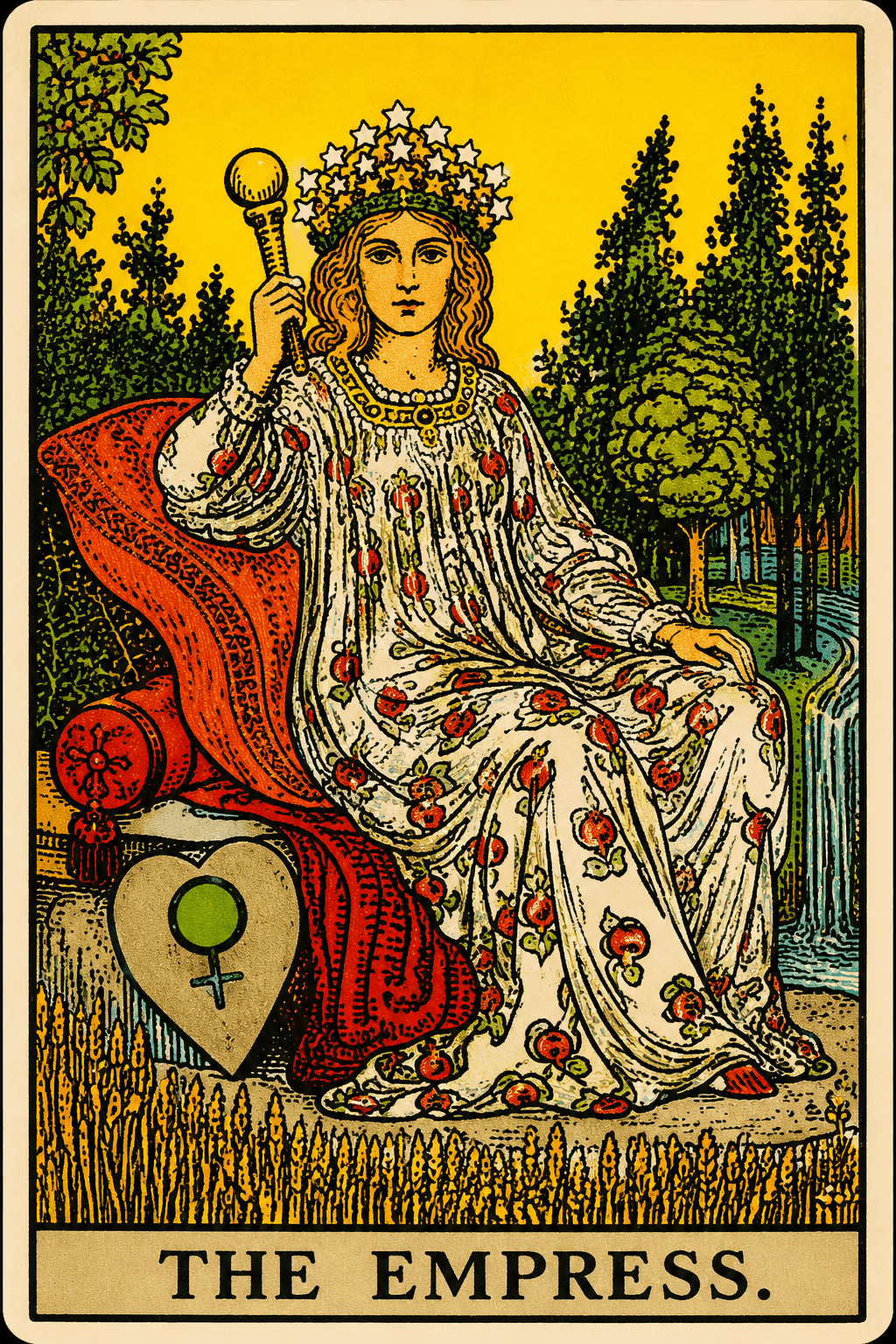
The Empress and The Emperor
The Empress and The Emperor together describe two complementary kinds of authority: abundance and structure, care and limit. Neither is the corrective for the other. The pairing usually means a situation needs both at once, or that someone is applying one where the other was required, which is the more common and more useful reading.
How these two cards change each other
This is the part neither card’s own page can tell you — what each one does to the other when they land together.
The Emperor gives The Empress boundaries. Abundance without structure has a specific failure mode: generosity that exhausts the giver, growth with no container, care that becomes indistinguishable from taking responsibility for someone else's life.
The Empress gives The Emperor a reason. Structure without warmth has its own failure mode: rules maintained past the point of usefulness, discipline that has forgotten what it was protecting. Together the cards describe each one's cure for the other's excess.
Read as a pair they frequently locate an imbalance rather than a harmony. In most readings one of the two is clearly dominant, and the question the combination raises is what the underrepresented card would have done differently.
The Empress and The Emperor in context
In family and parenting
The pairing's most literal reading, and often the correct one: two parental figures, or two modes of parenting. It appears around questions of how much to give and how much to require, and around adult relationships with parents where one supplied warmth and the other supplied rules. The cards do not assign either role by gender. That is a modern misreading of medieval titles.
In relationships
A partnership where one person carries the nurturing and the other carries the structure, which works until it calcifies into roles neither chose. The pairing is favourable about the combination and often pointed about the distribution: the reading usually improves when you ask who has been doing which and for how long.
In work and projects
Creative growth against operational structure. The Empress is the generative part, The Emperor is the framework that makes it survivable. In business readings the pairing frequently marks the point where something that grew organically needs actual systems, or where a system has strangled the thing it was built to support.
When one or both are reversed
The Empress reversed
Structure without nourishment: rules, discipline, and control operating over something depleted. This often describes burnout maintained by competence, where everything continues to function and nothing is being replenished.
The Emperor reversed
Care without boundaries. Generosity that has no limit, a situation where nobody will say no, or authority that has been abdicated. With The Empress upright the warmth is genuine, which is precisely what makes the missing structure hard to argue for.
Both reversed
Neither nurture nor structure available: a situation running on nothing, or two people each waiting for the other to hold it. Read this as a description of depletion rather than of conflict.
The common misreading
Often said: The Empress is the feminine card and The Emperor is the masculine one, so together they mean a man and a woman.
More accurately: The titles come from a medieval court structure and describe two modes of authority, not two genders. The Empress can perfectly well describe a father and The Emperor a mother, and in most readings neither card is a person at all. They are approaches being taken to a situation. Reading them as gendered narrows both cards for no interpretive gain, and it produces the specific error of looking for two people when the reading is describing one person's imbalance.
If you drew this, ask yourself
Which of these two have I been supplying, and what has gone unmanaged because I have not supplied the other?
The Empress and The Emperor: frequently asked questions
What do The Empress and The Emperor mean together?
Two complementary forms of authority, abundance and structure, care and limit. Together they usually describe a situation that requires both, or one where a person has been applying one when the other was needed. They also read literally as parental figures in family questions.
Do The Empress and The Emperor represent a man and a woman?
Not inherently. The titles are inherited from medieval court roles and describe modes of authority rather than genders. The Empress can describe a father, The Emperor a mother, and in many readings neither card is a person: both are approaches being taken.
Is The Empress with The Emperor a good combination?
Generally constructive, since each card supplies what the other lacks. The value in a reading usually comes from noticing which of the two is dominant, because a balanced pairing is less common than an imbalanced one and the imbalance is the information.
What does this pairing mean in a career reading?
Creative or generative work against operational structure. It often marks the point where something that grew informally now needs systems, or where systems have begun to constrain the thing they were built to protect. Which reading applies depends on which card is stronger in the spread.
Related pairings
All combinationsThe Hierophant + The Lovers
Tradition and personal choice in the same reading. The Hierophant is the inherited framework: convention, family expectation, the recognised form of a thing. The Lovers is what you would choose on your own terms. Together they often surface around commitment, and around whether an outside structure fits what you actually want.
The Chariot + Strength
Two ways of getting control of the same situation. The Chariot takes it by force of will and direction; Strength gets it through patience and refusal to escalate. Together they are rarely a contradiction. They describe a situation where one approach has been tried and the other is the one that will actually work.
The Magician + The High Priestess
Cards 1 and 2, and two opposite relationships to knowing. The Magician acts, declares, and makes things happen outwardly; The High Priestess holds what is not yet ready to be spoken. Together they ask whether the moment calls for doing something or for not moving until you actually know.
Draw your own
Combinations are most useful when they are your cards, in answer to your question.