
Tarot Spread
Yes or No Tarot Spread
A concise spread for a directional answer with nuance.
What the yes or no tarot spread is for
The yes or no tarot spread is a single card drawn against a question that has a binary shape. It is the most requested reading in tarot and the one most likely to be read badly, because a deck built to describe situations is being asked to return one bit of information.
Read honestly, it still works, as a leaning with a reason attached, not a verdict. The card tells you which way the situation currently tilts and, more usefully, what condition that tilt depends on. 'Yes, if you are willing to accept some uncertainty' is a far more actionable answer than 'yes'.
Yes or No Tarot Spread positions
1 position, read in order. Fix what each position means before you shuffle — deciding after you see the card is how a reading starts confirming what you already believed.
Position 1
Answer
A simple yes/no leaning with context.
When to use the yes or no tarot spread
- A genuine either/or you have already thought through and are stuck on.
- A quick directional check before a longer reading.
- Testing your own reaction: noticing you are disappointed by 'yes' is itself the answer.
- Questions where you control the outcome, so a conditional answer gives you something to act on.
When not to use it: Do not use it for questions about other people's decisions, medical or legal matters, or anything where you would actually follow the card against your own judgement. Tarot is a reflection tool; a binary format makes it easy to forget that.
How to read the yes or no tarot spread, step by step
Step 1
Phrase the question so both answers are survivable
If one of the two answers is unthinkable to you, you are not asking a question, you are seeking reassurance. Rephrase until you can genuinely picture acting on either result.
Step 2
Decide your reading convention before you draw
Fix the rules first: whether upright means yes and reversed means no, or whether you read the card's own tendency. Choosing the convention after seeing the card is how yes/no readings become self-confirming.
Step 3
Draw one card
One card, one draw. The single-card format is what keeps this spread honest: a second card is a new reading, not a clarification.
Step 4
Read the leaning and the condition
Note which way the card tilts, then find the condition attached to it. Most cards answer 'yes, if…' or 'no, while…'. That clause is the part of the reading you can actually use.
Step 5
Check your reaction before you act
Notice how you feel about the answer before deciding what to do with it. Relief or disappointment at a card is often clearer information than the card itself.
Worked example: 'Should I say yes to this offer?'
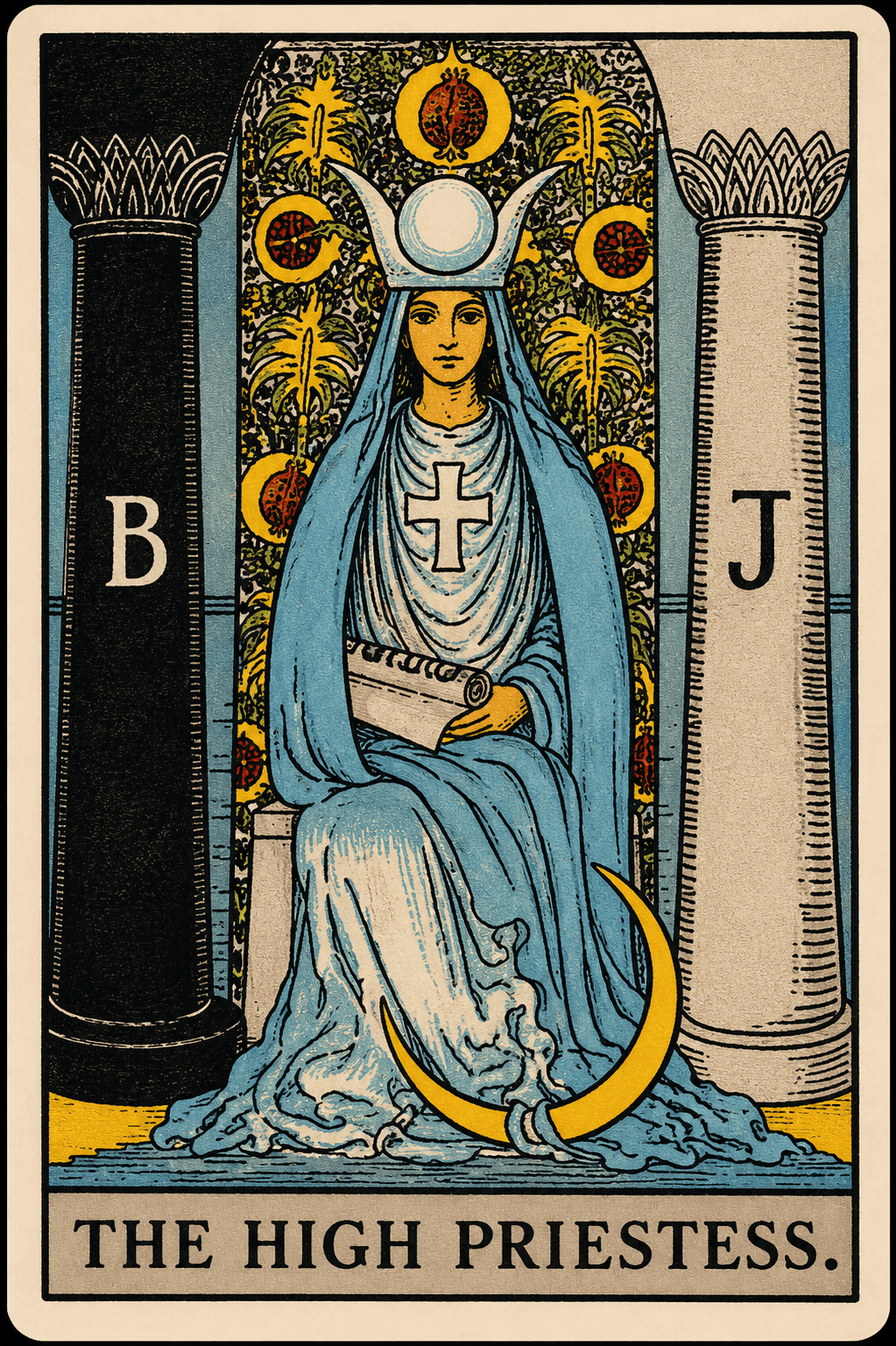
The High Priestess is one of the deck's clearest 'not yet' cards. It leans neither yes nor no, because it describes a situation where the relevant information has not surfaced. Read as a binary that is frustrating; read as a condition it is precise: something material about this offer is still undisclosed, and the honest move is to ask the question you have been avoiding asking before answering at all. A card that refuses the binary is still a usable answer.
Common mistakes with the yes or no tarot spread
Drawing again when you get 'no'
The single most common way this spread gets misused. Best-of-three is not a reading, and you already know which answer you wanted, which is itself worth noticing.
Dropping the condition and keeping the verdict
'Yes, if you commit to deliberate action' is not the same as 'yes'. The conditional clause is the entire useful content of the reading.
Asking about someone else's choice
Cards describe your situation and your framing of it. A yes/no about what another person will decide returns a reflection of your own expectation, and reading it as fact is where tarot stops being a reflection tool.
Cards that show up in this spread
All 78 card meaningsYes or No Tarot Spread: frequently asked questions
How do you do a yes or no tarot reading?
Phrase a question where both answers are acceptable, fix your convention before drawing (upright/reversed, or the card's own tendency), draw one card, and read both the leaning and the condition attached to it. Do not draw again for a better answer.
Which tarot cards mean yes?
Cards with forward, affirming energy generally lean yes: The Sun, The Star, the Aces, the Three of Cups, the Ten of Cups. Cards describing delay, withdrawal, or loss lean no, and several cards, such as The High Priestess and The Hanged Man, answer 'not yet' rather than either.
Are yes or no tarot readings accurate?
They are best read as a leaning with a condition, not a prediction. Tarot reflects how a situation is currently shaped and what it depends on; treating a single card as a verdict on an outcome you do not control is the point at which the reading stops being useful.
What if the card is neither yes nor no?
That is a legitimate result and usually the most informative one. Cards like The High Priestess, The Hanged Man, and the Two of Swords describe situations where the information needed to decide has not arrived yet: the answer is to go get it.
Other tarot spreads
All spreads3 cards · General
Past Present Future
A classic spread for tracing how a situation unfolds.
3 cards · Love
Love Reading
A relationship-focused spread for emotional clarity.
5 cards · Love
Relationship Reading
A broader spread for communication, needs, and shared direction.
3 cards · Career
Career Reading
A practical spread for work direction and professional choices.