Card Combination
The Fool and Death
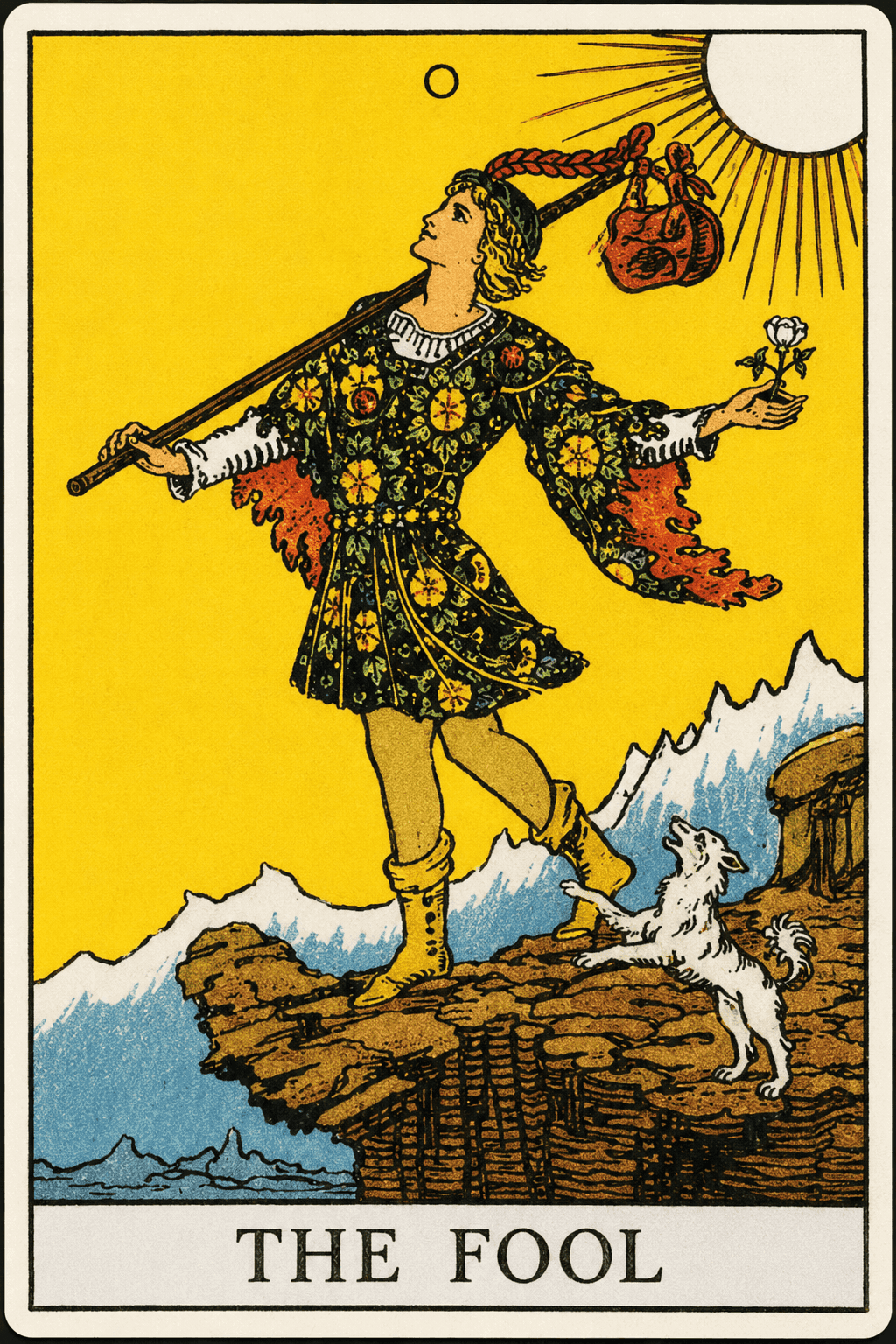
The Fool and Death together describe an ending and a beginning with nothing between them. Death closes something for good; The Fool steps out with no plan and no history attached. Together they describe starting over because there is no version of the old thing left to return to.
How these two cards change each other
This is the part neither card’s own page can tell you — what each one does to the other when they land together.
Death removes The Fool's option of turning back. A Fool beginning is usually reversible in principle, however unwise reversing would be. Here the previous arrangement is gone, which changes the step from a risk into the only move.
The Fool makes Death's ending survivable in practice rather than just in theory. The transformation is not merely conceptual: something is being done next, and that is what distinguishes this from an ending with no follow-on.
Together they compress a sequence that normally takes time. Most endings are followed by an interval; this pairing describes the version with no gap, which is disorienting even when the direction is right.
The Fool and Death in context
In a major change
A career, relationship or identity ending and something starting immediately. Frequently not chosen: the pairing often describes someone who had no interval available and began again because standing still was not an option.
In identity
A version of yourself that has genuinely ended. The Fool's lack of history is the point here, and it is both the relief and the difficulty of this combination.
In a decision
Where the old arrangement has already ended, this pairing argues that the decision is about what comes next rather than whether to let go. The letting go has happened.
When one or both are reversed
Death reversed, The Fool upright
Beginning something while the old thing is still being held. Two lives running at once, which is exhausting and generally resolves in one direction.
The Fool reversed, Death upright
The ending complete and no step being taken. Standing where something used to be, which is a normal stage and becomes a position if extended.
Both reversed
Neither conclusion nor beginning. Usually something that has not finished cleanly enough to move on from, which is harder than a clear ending.
The common misreading
Often said: Death and The Fool together means recklessness after a loss.
More accurately: The Fool describes acting without a plan, which after a Death is frequently the only available option rather than a failure of judgement. Labelling it reckless adds a criticism to someone already without a fallback, and the pairing is better read as describing necessity than poor decision-making.
If you drew this, ask yourself
What is genuinely gone here, and what am I still treating as available?
The Fool and Death: frequently asked questions
What do The Fool and Death mean together?
An ending immediately followed by a beginning. Death closes something permanently and The Fool steps out without a plan, so together they describe starting over with nothing to return to.
Is this a bad combination?
Disorienting rather than bad. The ending is real and the pairing specifically includes what happens next, which many ending combinations do not.
Does The Fool mean I am being reckless?
After a Death, acting without a plan is frequently the only option rather than a lapse in judgement. The pairing describes necessity more often than poor decisions.
What if I cannot start again yet?
That is The Fool reversed with Death upright: the ending complete and no step taken, which is a normal stage and only becomes a problem if it settles.
Related pairings
All combinationsDeath + The Star
An ending followed by relief rather than dread. Death closes something permanently; The Star is what arrives in the space afterwards. Together they describe a conclusion that turns out to have been survivable, and often overdue.
Ten of Swords + The Fool
The worst of it, and then a first step. The Ten of Swords is an ending with nothing left to lose; The Fool is beginning again with no plan. Together they describe the specific freedom of having already hit the bottom.
The Hanged Man + Death
The pairing that separates waiting from ending. The Hanged Man is voluntary suspension. You could move and are choosing not to. Death is not optional. Together they usually mean a pause has run its course, and what could once have been waited out now has to be let go.
Draw your own
Combinations are most useful when they are your cards, in answer to your question.